


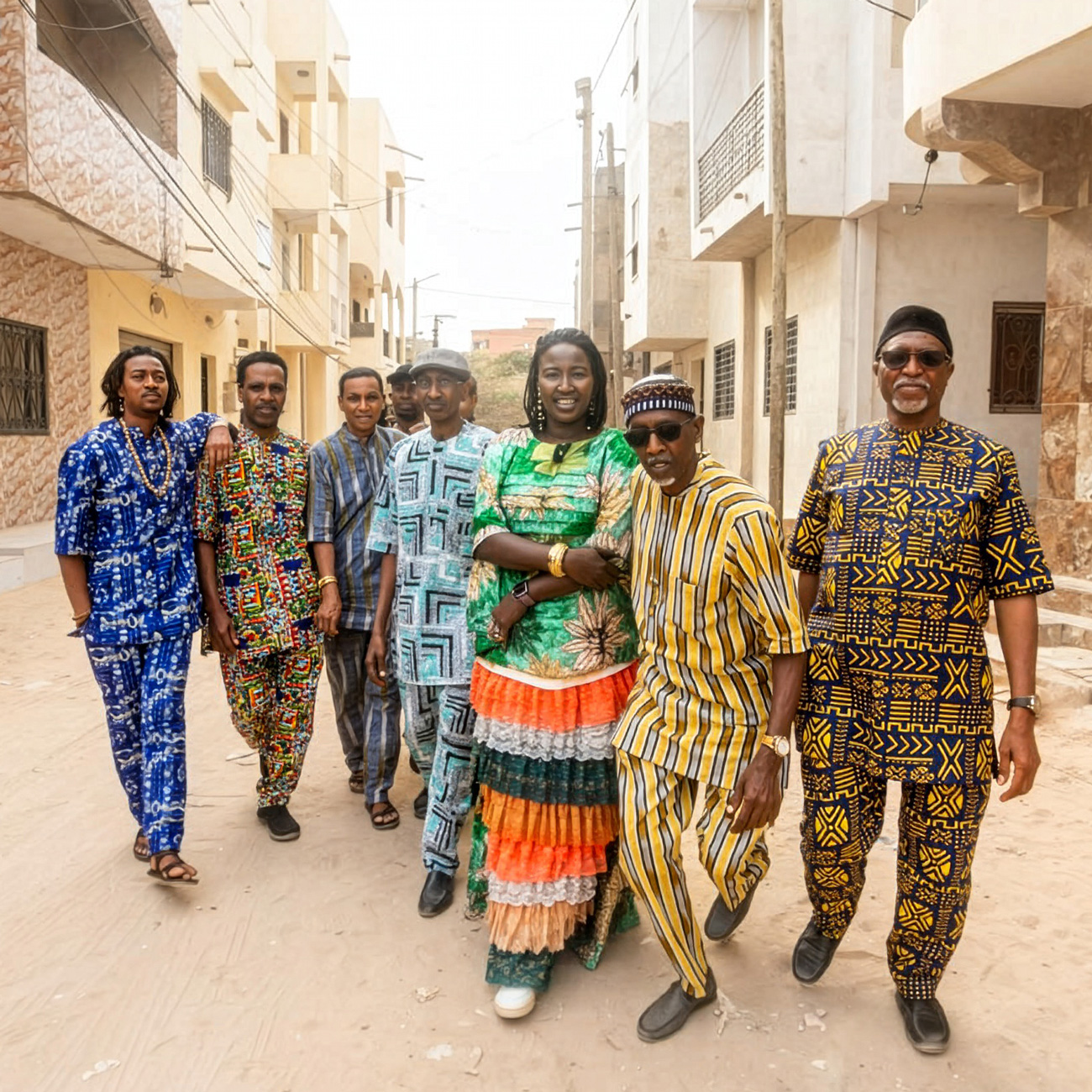
Orchestra Baobab
(SN)
There are bands that belong to a city. Orchestra Baobab belongs to an entire ocean. When it first emerged in Dakar in 1970, Senegal was in the early days of its independence, and the capital was buzzing with nightclubs, intellectuals, sailors, Cuban musicians on well-worn records, and rhythms from all over West Africa. It was in this diverse and cosmopolitan atmosphere that one of the most elegant and hypnotic orchestras in the history of African music was born.
The band formed as the house band at the Baobab Club, a nightspot frequented by Dakar’s cultural and political elite. But what began as club music quickly evolved into a unique musical language. Orchestra Baobab struck a rare balance between tradition and urban sophistication: son cubano, Congolese rumba, Latin jazz, Mandinka griot, Wolof, Casamance music and Creole rhythms coexisted with disarming naturalness.
Whilst other African bands sought modernity through electric funk or American soul, Orchestra Baobab chose a different path: that of subtlety. Fluid guitars, understated horn sections, warm percussion and melancholic vocals created a nocturnal, elegant, almost cinematic sound. Music that always seems to emerge from the depths of a collective memory.
The group brought together musicians from different ethnic groups and regions of West Africa — Senegal, Togo, Nigeria, Guinea, Casamance — and this diversity became their true language. They sang in Wolof, Mandinka, Diola, French and Spanish. Each song felt like a transatlantic journey between Dakar, Havana and Bissau.
In the 1970s and early 1980s, they became an institution in Senegal. But with the rise of Youssou N’Dour’s mbalax and faster, more electric sounds, Orchestra Baobab eventually lost ground. In 1987, they quietly disbanded. It seemed like the end of an era
Except that some songs refuse to fade away. In the 2000s, thanks to the enthusiasm of musicians such as Nick Gold and Youssou N’Dour, Orchestra Baobab returned to the international stage. The album Specialist in All Styles (2002), produced by Youssou, brought that warm, elegant and timeless sound back to the world. The reunion was no exercise in nostalgia. It was confirmation that there was something timeless there.
Today, listening to Orchestra Baobab is like entering an emotional landscape where Africa and the Caribbean remain linked by the same invisible thread. There is in their songs a rare serenity, an unostentatious sophistication, a luminous melancholy that seems to outlast all eras.
Live, Orchestra Baobab transforms the stage into an Atlantic hall of intertwined memories. The guitars glide without haste, the brass breathes like warm tides, and the voices carry decades of stories, departures and returns. In a fast-paced world, their music reminds us that elegance can also be revolutionary.