


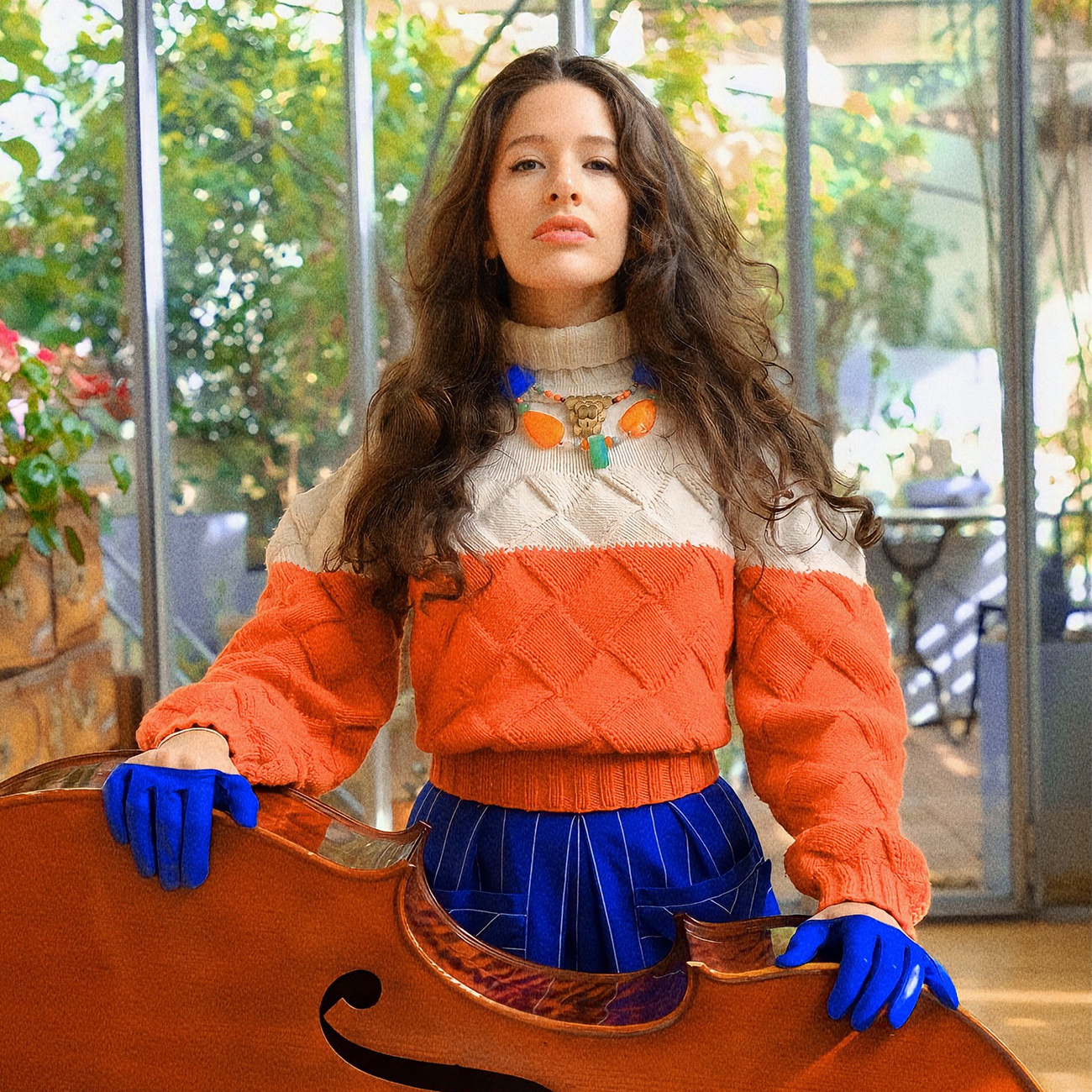
Photo © Roxane Cassehgari
Ëda Diaz
(CO/FR)
Colombia is a country with a wealth of music too vast to count. Vallenato on the Caribbean plains, bambuco in the Andean mountains, currulao on the black Pacific coast, the bolero that arrived from Cuba and never left, and the tango that Medellín has embraced with a devotion that even the Argentinians envy. All this coexists in a land of dizzying diversity that the Western world has, for far too long, reduced to a single image: the cumbia. Eléonore Diaz-Arbelaez grew up knowing there was so much more. She also grew up knowing that this ‘so much more’ coexisted within her alongside Paris, alongside Brittany, alongside European conservatoires and concert halls. And that the only honest way to make music was not to choose, but to be everything at once.
Her stage name, Ëda, is both an abbreviation of her first name and a declaration of uniqueness: that diaeresis over the e that exists in neither French nor Spanish, that belongs to no canonical alphabet, that is purely hers. She was born in Paris, the daughter of a Breton mother and a Colombian father from Medellín. From a very young age, her life has been a constant journey between two continents, two languages, two ways of hearing the world.
Throughout her artistic career, Ëda has explored choirs, electronic experimentation and hybrid bands, eventually arriving at her own unique universe, which encompasses bambuco, bullerengue, cumbia, vallenato and other Latin American rhythms, reimagined with synthesisers, drum machines machines and an almost cinematic sensitivity. In her music, one hears both the echo of the mountain peasants’ voices and the shadow of Bristol’s smoky trip-hop, French alternative pop, and a certain kind of electronic music that relishes detail and space. Each song is an exercise in reconciliation: between tradition and futurism.
Ëda Diaz’s sound is a body in constant flux: the double bass, laden with effects, traces bass lines that resemble underground rivers; above, the voice oscillates between a confessional whisper and ritual chant, in Spanish, French or somewhere in between where the languages meet.
In 2024 she released the album Suave Bruta, a perfect title for the music it contains: soft and raw at the same time, just as Ëda herself described her identity: ‘two rich and complementary aspects that I have always seen as opposites”. The double bass is the insistent pulse upon which everything else unfolds: raw salsa, electrified currulao, Colombian dembow, old-school bambuco layered with synths, ghostly boleros. The influences are stated without hierarchy: Björk and James Blake alongside Miles Davis and Juana Molina, García Márquez and Pablo Neruda in lyrics that speak of love, death and the torments of the modern world. Samples of the noise from a hairdressing salon, of tropical birds, of classic Latin American melodies cut up and pasted together. A production that evokes both the city and the savannah simultaneously, elegant and raw, introspective and undeniably danceable.
Ëda Diaz brings to Med a vibrant portrait of a mixed-heritage generation, which no longer sees itself reflected in rigid boundaries and invents other ways of being.