


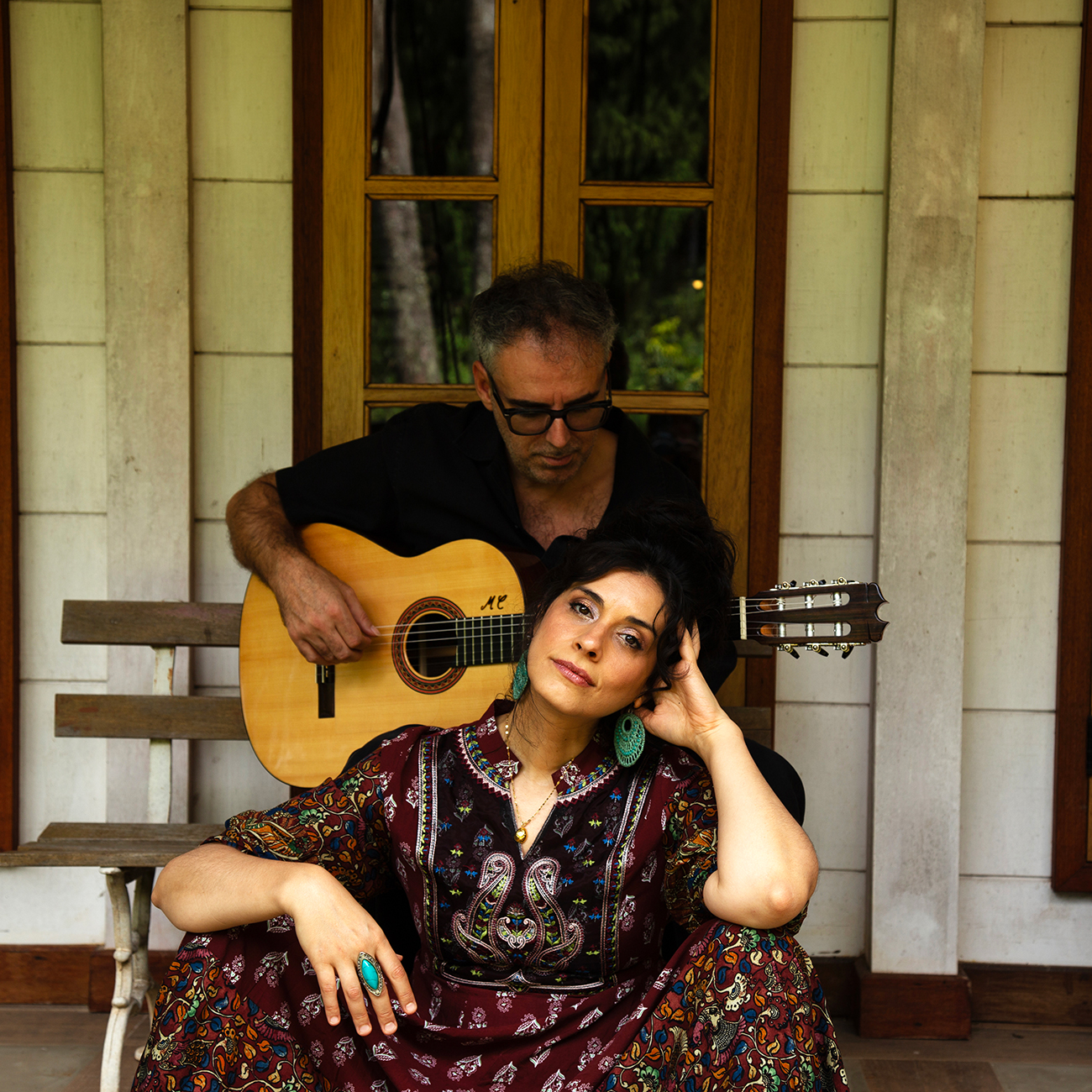
Manuel de Oliveira & Bianca Gismonti
(PT/BR)
There are encounters that only music can explain. Portugal and Brazil share an ocean, a language and a particular kind of melancholy, that ability to transform longing into beauty. But they also share something less often spoken of: a tradition of instrumental music that refuses to be merely an accompaniment, that insists on having a voice of its own, on telling stories without words. It is within this tradition that Manuel de Oliveira and Bianca Gismonti find their place, and it is from this that they forge their own path.
When a guitarist from Guimarães and a pianist from Rio de Janeiro sit together on stage, without a score or a roadmap, they are doing more than just making music: they are renegotiating that long and sometimes painful history, in real time, with two instruments and all their accumulated life experience.
Manuel de Oliveira learnt the guitar from his father, Aprígio Oliveira, and it was through his own efforts that he travelled the world in search of other traditions: flamenco, South American music, fado. Largely self-taught, he has built a language that is immediately recognisable in its constant evolution, always exploring the same themes: borders, identity, territory, community. What does it mean to belong to a place? What remains when one leaves? In 2022, the album Ibéria 20|22, recorded with Jorge Pardo and Carles Benavent, the same musicians with whom he made his debut twenty years ago, earned him the Carlos Paredes Prize, the highest honour in Portuguese instrumental music.
On the other side of the ocean, Bianca Gismonti, daughter of pianist, guitarist and composer Egberto Gismonti and actress Rejane Medeiros. She grew up surrounded by music just as one grows up in a house, inevitably, without choice and without regret. At the age of nine she began studying the piano; by fifteen she was already accompanying her father on tours around the world. The legacy of Egberto Gismonti, one of the most unique architects of Brazilian instrumental music, who fused European classical music, American jazz and Amazonian rhythms into a body of work of rare depth, is in every note Bianca plays. But the voice she has forged is entirely her own.
Over the course of a two-decade career, Bianca has toured Europe, Asia and the Americas with the Duo Gisbranco and with her own trio; she has collaborated with Chico César, Jacques Morelenbaum, Nana Vasconcelos and Mônica Salmaso; and has released a discography that grows in depth and daring with every instalment. Manuel de Oliveira, for his part, has built a solid European reputation over more than twenty years. He has performed alongside Brad Mehldau, Chick Corea, Mike Stern and Richard Galliano.
The partnership between the two emerged with the naturalness of things that should have happened sooner. In early 2026, they gave eight concerts in Brazil: Florianópolis, Blumenau, Porto Alegre, Rio de Janeiro, Belo Horizonte, São Paulo. In every venue, the same experience is described by the audience: the sensation of witnessing a dialogue in which silence matters just as much as sound.
The repertoire is entirely original, situated somewhere between fado, jazz and MPB without fully belonging to any of the three. Guitar and piano breathe together, explore polyrhythms, and construct soundscapes where improvisation is not ornament but structure. Between them, silence becomes a landscape. Sound transforms into an encounter that Med is honoured to host.
Manuel de Oliveira
Bianca Gismonti