
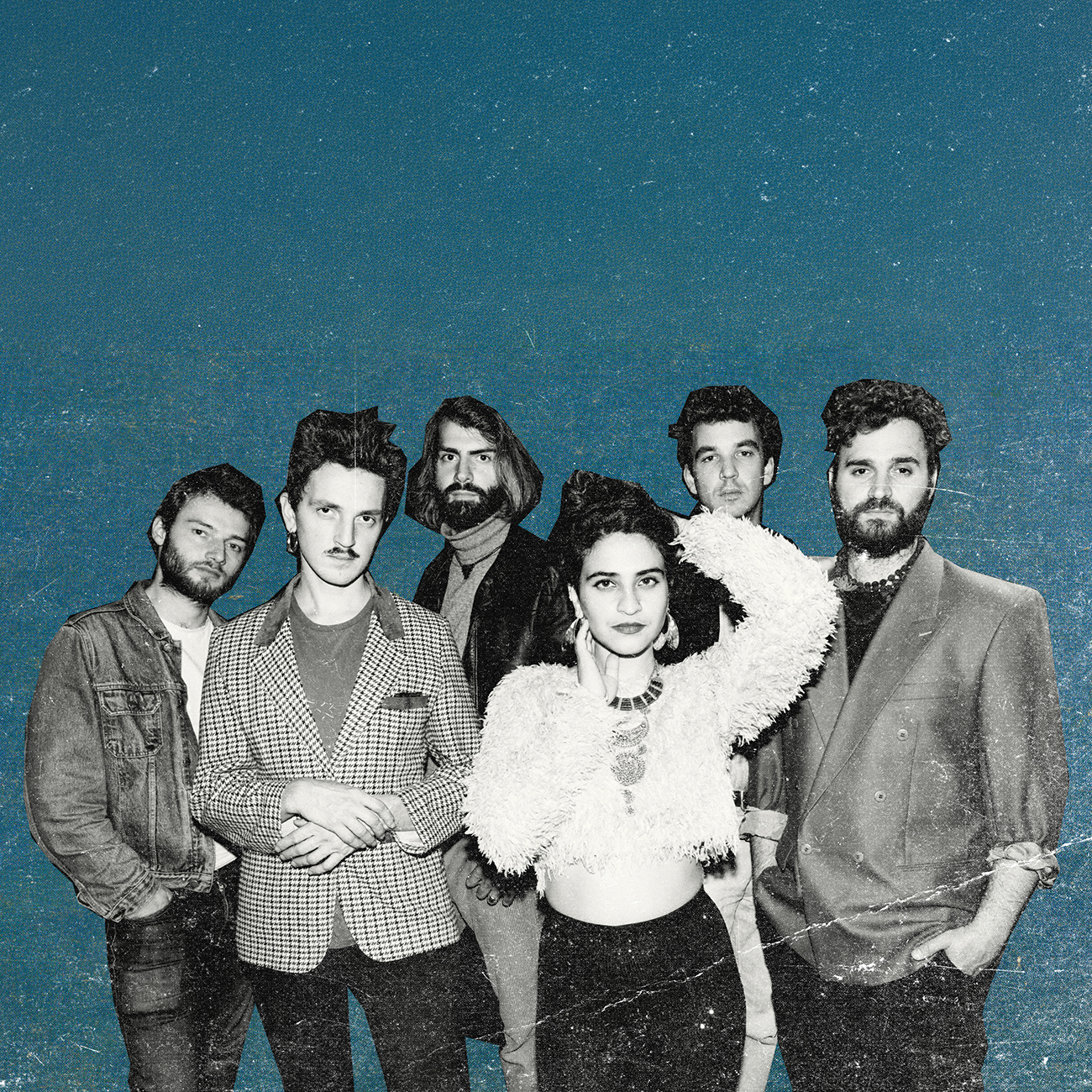
Photo © Sylvain Gripoix
Sarab
(SY/FR)
By 2011, Syria had ceased to be merely a country and had become an open wound on the world map. The revolution, the civil war, the exodus of millions – all this unfolded whilst Climène Zarkan was living in Paris, the daughter of a Syrian father and a Franco-Lebanese mother, having been raised in Damascus until the age of twelve before returning to the French capital. She grew up between two languages, two cultures, two worlds that history sought to tear apart. When she decided to sing in Arabic in a city that does not speak Arabic, she was making a political choice as much as an artistic one: a refusal to let die what the language carries within her.
Sarāb means ‘mirage’ in Arabic, and there is a whole poetry to this choice of name: something that can be seen but not touched, that seems real yet is not, that appears in the desert as a promise and vanishes as we draw near.
In 2018, Climène Zarkan and guitarist Baptiste Ferrandis met in Paris. They began as a duo performing songs composed by Climène’s father, Bachar Zarkan, a renowned Syrian lute player. They soon realised that what they had on their hands was more than just a two-person project. They expanded to six musicians: Thibault Gomez on piano, Timothée Robert on bass, Paul Berne on drums and trombonist Robinson Khoury. All are central figures on the Parisian experimental jazz scene. Sarāb was formed.
The collective began to be described as jazz. They rejected that. Is it World music? They shrugged. The truth is that their music is a collision: post-punk and Arabic poetry, maqamāt and analogue synthesisers, Climène Zarkan’s voice at times whispering, at times howling through a megaphone, rhythms that teeter on the brink of breaking. The lyrics draw on the Syrian poet Maram al-Masri, the Libyan-Sudanese writer Muhammad al-Fayturi, and Zarkan’s own voice on exile and memory: ‘there are words in Arabic that I no longer recognise’ and singing them is the way to reclaim them.
The self-titled debut album, released in 2019, featured reinterpretations of traditional songs, many about love, but also the haunting Tiri, about Palestinian freedom. In 2021, Arwāh Hurra (‘Free Souls’) revealed a band already functioning as a genuine creative collective, with each musician bringing their own perspective to a shared vocabulary. In 2023, Qawalebese Tape, a filmed EP born of a deep immersion in the millennia-old traditions of Egypt and Syria, bordered on the sacred: music that seems to have arrived from another time, dusted off cassette players and yellowed postcards, infused with contemporary influences.
Earlier this year, Sarāb released the most ambitious and devastating album of her short career: Mīt Warde / Cent Roses (‘One Hundred Roses’), a tribute to all the martyrs and the disappeared of the Syrian revolution and to their families. Recorded in a Parisian studio renowned for seminal rock albums, the record is, in her own words, ‘a visceral sonic odyssey where maqamāt, political commitment and the power of rock converge’. Ten tracks including ‘CEASE FIRE NOW’ and ‘Electric Yasmin’. Titles that need no translation. Climène Zarkan does not sing about Syria: she sings Syria, with all its destroyed beauty and its stubbornly living memory.
Med therefore welcomes a band in a state of grace and fury at the same time.