

Photo © Ana Maria Dinis
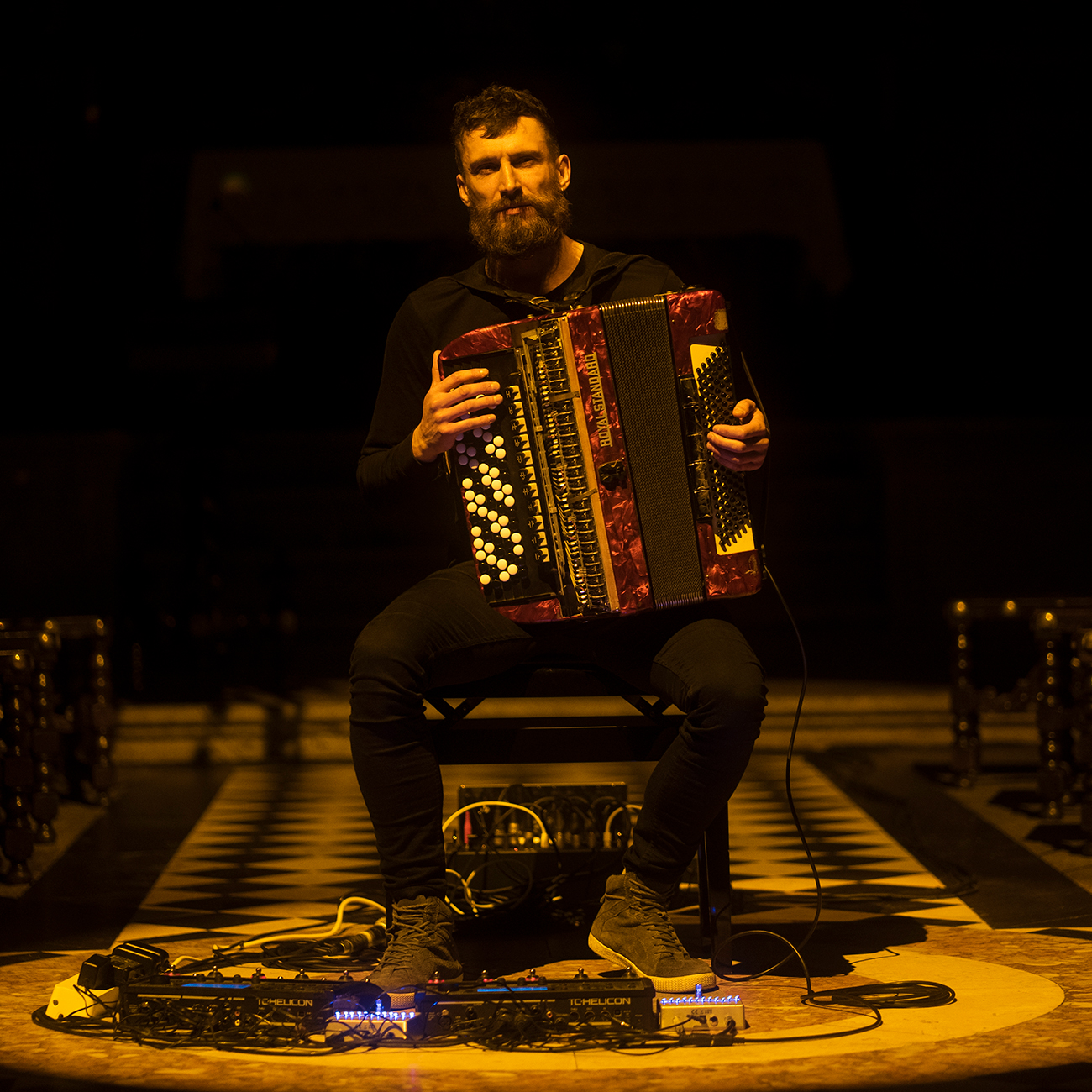
Yegor Zabelov
(BY/PL)
When the Belarusian people took to the streets following the rigged presidential elections of August 2020, Lukashenko responded with violence, imprisonment and exile. Among those who left were musicians, writers, artists and academics, the most creative generation of a country that the regime treated as its private property. Yegor Zabelov already had the world as his territory before this rupture, but the rupture made him realise, more keenly, that carrying a country’s culture in one’s luggage can be an act of resistance as urgent as any other.
Yegor Zabelov, now based in Poland, grew up in Mogilev, a city in eastern Belarus, a few kilometres from the Russian border. His father was a musician. He was Yegor’s first accordion teacher, when Yegor was seven years old. This direct, hand-to-hand transmission shaped in him a relationship with the instrument that would never be purely technical: it was always also emotional, familiar, almost biological. He studied at the Mogilev Conservatory and completed his training at the Belarusian State Academy of Music in Minsk. An institution of strict classical rigour that provided him with the technical foundation, but did not conform him. Even whilst still a student, he began to compose. His first work, a Sonata that included references to The Prodigy, won first prize in the Conservatoire’s composition competition. It was a declaration that the boundaries between classical and popular music were of no concern to him.
In 2002, he won the International Competition for Folk Musicians in Belarus. In 2005, he founded the duo Gurzuf with drummer Artyom Zalessky. It was with this project that he toured Europe from festival to festival for years, including the Acordeões do Mundo festival in Torres Vedras. In 2010, he received the Sergey Kuryokhin Prize for Contemporary Art in the Ethno-Mechanica category, in recognition of his unusual fusion of folk tradition with electronic experimentation. In 2011, he founded the Yegor Zabelov Trio, with Alexander Efimov on bass and Vladimir Beger on drums. His flagship project.
Yegor Zabelov does things with the accordion that most accordionists would never imagine possible. His stated influences are as diverse as they are revealing: Philip Glass, Steve Reich, Michael Nyman and Arvo Pärt on the classical minimalism side; the Finnish Kimmo Pohjonen on the side of extreme experimentation with the instrument; and the Esbjörn Svensson Trio on the side of introspective Nordic jazz. On stage, the accordion ceases to be what one recognises and transforms into something stranger and vaster: a generator of soundscapes ranging from post-rave ambient, avant-garde jazz, neoclassicism and beatless electronica. The British publication Louder Than War wrote that ‘no one would have imagined it was possible to make sounds similar to those of Aphex Twin on an accordion’.
There are musicians who play well. There are musicians who invent a new language. And there are musicians who, in inventing a new language, carry with them the weight and memory of a country that the world insists on ignoring. Yegor Zabelov is all three at once: virtuoso, inventor and witness. At a time when Belarus resists in silence and its culture survives in the luggage of those who have left, listening to him and seeing him at Med is also a way of not looking the other way.