


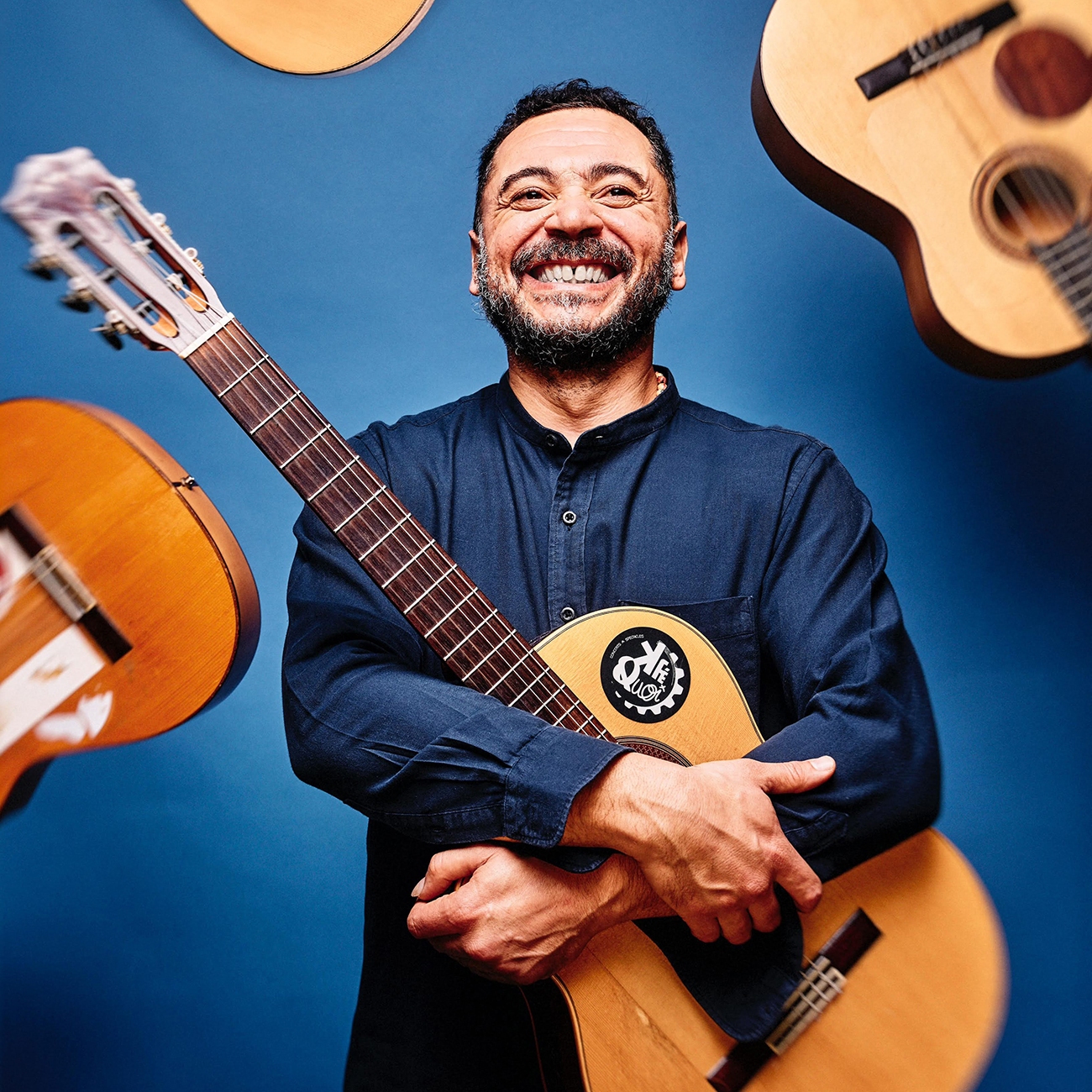
Dima Libre – Labess Trio
(DZ/CA)
In 2003, Algeria was a country recovering from its most recent wounds. The civil war of the 1990s, which claimed between fifty thousand and two hundred thousand lives, had left deep scars on society. Many left. Some took with them only a guitar and the certainty that there was something to be said that their country of origin was not yet ready to hear. Nedjim Bouizzoul was eighteen when he emigrated to Quebec with his mother and sisters. He arrived in Montreal in the summer of 2003 with no money, no network, no plan. Just a rough voice and an instrument in his hands.
The beginning was humble to the point of poetry: Nedjim started playing in the Montreal metro to earn money for food. The city, however, has ears, and other professional musicians on the local scene soon took notice of him. Collaborations multiplied. He soon realised that exile is not experienced in the singular: ‘exile, when lived intimately, is in the plural.’ From this understanding, the band was born, and with it, the name. Labess means, in Algerian Arabic, ‘all is well’. It is what you say when someone asks how you are, regardless of how you really are. In these two small words lies a whole philosophy of joyful resistance.
Labess’s music is what happens when Algerian chaâbi —the music of the working-class neighbourhoods, the music of Nedjim’s ‘older brothers’ in Hussein-Dey —meets Gypsy rumba, flamenco, the gnawa sounds of the Maghreb, the Afro-Latin rhythms of Colombia and the cosmopolitanism of Montreal. Nedjim sings in Algerian Arabic, Spanish and French, sometimes within the same song, sometimes without warning which language comes next, because exile is also this: the impossibility of inhabiting a single language. His voice is deep and committed, possessing that quality of someone who has never sung to convince anyone, but simply to ensure that what needed to be said was not silenced. The krakeb, the metal castanets of the gnawatradition, intertwine with clarinet, trumpet, guitar, bass and percussion in an orchestra that is, in itself, a map of the world.
Before arriving in Québec, Nedjim lived for two years in Colombia, where the rhythms resonated with the memory of the first African slaves exiled to Latin America, where the Spanish and Arabic guitars share roots deeper than the atlases suggest. That Colombian immersion was kept in reserve, and emerged in 2021 with Yemma (“mother”), the fourth album, dedicated to the woman who sacrificed everything to give him wings.
Labess arrives at Med in the midst of celebrating 20 years on the road. The latest album Dima Libre (2024) fuels an even more collective show. The concert is conceived as a journey: from childhood in Algiers to exile in the Americas, to a present in which the band asserts itself as a pan-Mediterranean and transatlantic voice. On stage, it is living proof that, in a world of borders, music remains a place where ‘everything is alright’.