
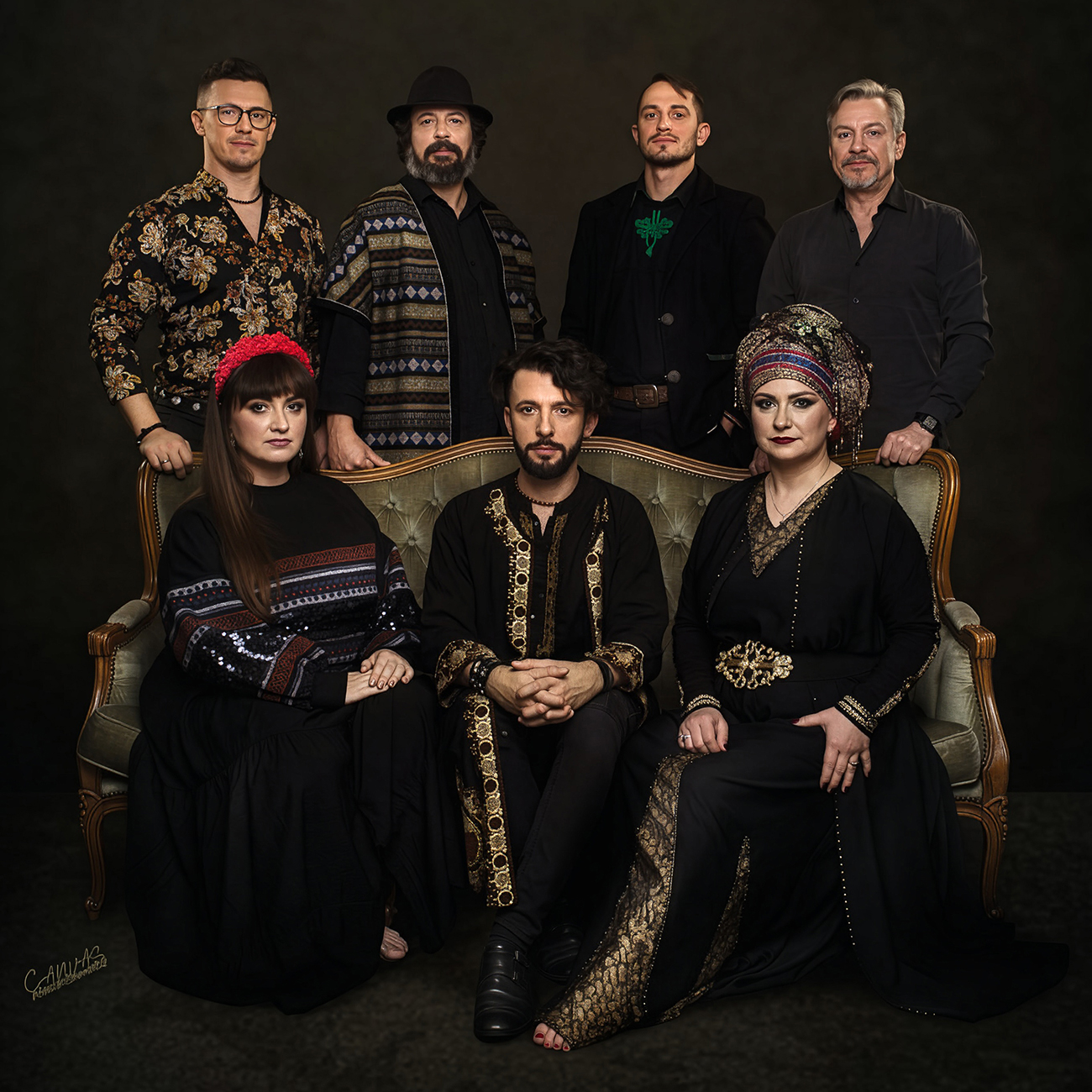
Photo © Marcin Szymański
Dikanda
(PL)
Central Europe knows all too well the weight of borders. Szczecin, a Polish city on the banks of the Oder, was for centuries a place of passage, conquest and the reconstruction of identity: German, Polish, and everything that lay between the two. It is on this historically unstable ground that Dikanda was formed in 1997.
The name says it all: dikanda is, in a Central African language, the word for a family that has come together on the road. Vocalist and accordionist Anna Witczak-Czerniawska, alongside guitarist Piotr Rejdak, began by playing on the streets of Europe, improvising songs to fund their travels, until the jam sessions evolved into a permanent band. This is precisely the spirit of the group, which lives and works as a small, loving community, where each musician adds their own emotional geography to the group’s sonic map.
Their first album, Muzyka czterech stron wschodu (‘Music of the Four Corners of the East’), released in 1999, was a statement of intent: to catalogue the soundscape of the East with the seriousness of an ethnomusicologist and the passion of someone who simply cannot stop dancing.
Dikanda’s frame of reference is, therefore, the East in a mythical and anthropological sense. A place that extends far beyond geographical boundaries: the Balkans, the Middle East, the Arabian Peninsula, India, Africa, the Gypsy world of the Carpathians.
Dikanda does not sing in Polish, nor in Macedonian, nor in Romanian, nor in Arabic. Or rather, it sings in all of these and in something else that does not exist in any dictionary. One of the most distinctive traits is the creation of made-up words in the song lyrics, creating a language of their own called dikandisz, the language of emotion and the heart. It is neither a trick nor a gimmick: it is the honest admission that there are feelings no existing language can contain, and that the only possible answer is to create a new one. At a time when identities are closing in on themselves and difference is frightening, they propose the opposite: a language that nobody speaks but everyone understands.
The result is music that communicates beyond linguistic boundaries: those who do not understand the lyrics grasp the gesture, the vibration, the urgency, with songs that oscillate between frenetic dances and hypnotic ballads, passing through irregular metres typical of the Balkans and Eastern scales full of tension and brilliance.