


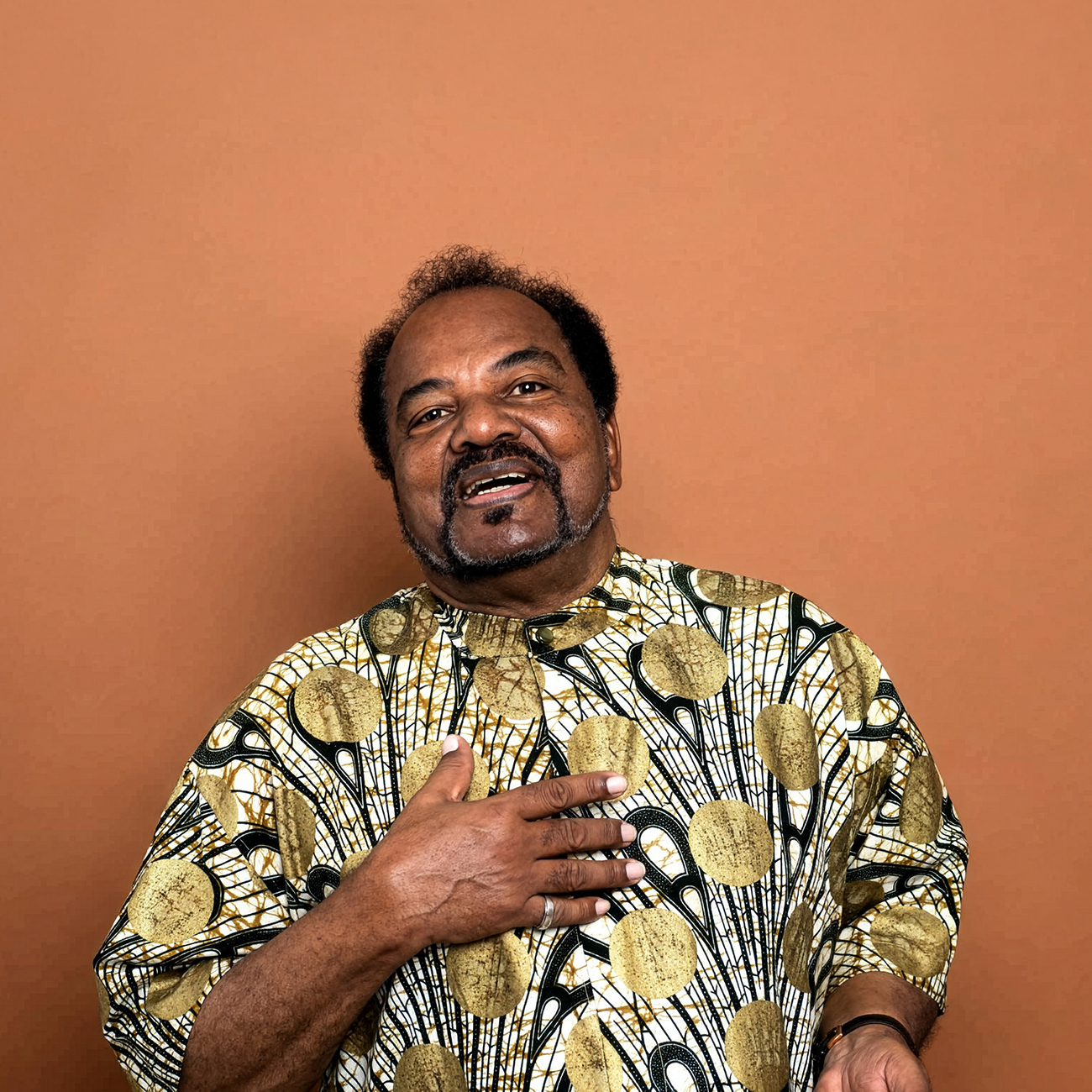
Bonga
(AO)
When Bonga first made his voice heard, Angola was still a nation struggling to assert its freedom. His songs resonated in the hearts of those who dreamed of an end to colonial rule and the birth of a distinct identity. He sang semba at a time when it was already a form of resistance: a hybrid rhythm, with Afro-Lusophone roots, where body and words moved as one. At a time when music was both a weapon and a refuge, Bonga raised his voice as a symbol of unity and liberation. He was persecuted, exiled, but never silenced. His singing travelled from Luanda to Lisbon and from there to the world, carrying the memory of a people.
Born José Adelino Barceló de Carvalho in Kipiri, on the outskirts of Catumbela, in 1942, Bonga grew up amidst the batuques of Angola and the records arriving from across the Atlantic. Before becoming a musician, he was a top-level athlete and even represented Portugal in the 400 metres. But when the winds of change began to blow across Africa, he swapped the name of a runner for that of a messenger: Bonga Kuenda. That is to say, ‘he who crosses borders running’. From then on, he did indeed run, but in pursuit of freedom. Bonga set off for the Netherlands, for France, for the exile that so many knew and few were able to transform into a life’s work.
Having settled in Europe in the 1970s, Bonga became a leading voice of the Angolan diaspora. His debut album, Angola 72, blended acoustic guitars and reco-recos, saxophone and melancholy, and gave semba a new horizon: urban, poetic, universal. Influenced by Liceu Vieira Dias, Rui Mingas, morna and fado, he reinvented semba as a hybrid language, somewhere between lament and an invitation to dance.
Over more than five decades, he has built a body of work that is also an archive: from the influences of batuque and rebita to the dialogue with jazz and Cape Verdean music, and the Kimbundu language, which he insists on singing. His songs are home to stories of fishermen, of women who wait, of children who grow up too quickly, of a continent that the West stubbornly refuses to listen to with due attention. Bonga’s voice is unmistakable: hoarse, earthy, almost ancestral. It carries the salt of the dirt roads and the sweetness of Luanda’s backyards.
At 84, with over half a century of songs and resistance behind him, Bonga returns to MED, eight years after, with the same vigour as ever.